Move money in one balanced call.
A transaction is a set of postings whose debits always equal its credits. Send a simple transfer or split one payment across many accounts, pending or posted, and Ledgr writes it to an immutable journal and updates every balance atomically.
Post a payment, fee, and payout together.
List the legs, and Ledgr checks that debits equal credits before it accepts anything. The transfer, the platform fee, and the merchant credit settle as one atomic entry, or none of them do.
const tx = await ledgr.transactions.create({idempotencyKey: "settle_5f2a",description: "Card settlement",status: "posted",entries: [{ account: "customer", direction: "debit", amount: 10_000 },{ account: "merchant", direction: "credit", amount: 9_700 },{ account: "fees", direction: "credit", amount: 300 },],}); tx.status; // "posted" · debits === creditsThree legs, one entry. Debits and credits net to zero, so the books can never drift.
Correct by construction, not by convention.
Double-entry is centuries old for a reason. Ledgr enforces it at write time, so the property you rely on for audits holds on every single transaction.
Debits equal credits
Every transaction is rejected unless its sides balance. Money always leaves one account for another, so value is never lost or invented.
Atomic by default
Either the whole entry is written or none of it is. A partial settlement is impossible, even across many accounts.
Traceable forever
Each posting links to the transaction that made it. Any balance can be explained by the exact entries behind it.
Authorize now, settle when you are ready.
Post a transaction outright, or record it as pending and reserve the payer's funds until you confirm it. Corrections are first-class too: a reversal is a new, opposite entry, never an edit. Ledgr enforces which transitions are allowed.
Everything a money movement needs.
Multi-leg entries
Split one payment across payer, payees, fees, and taxes in a single balanced transaction.
Idempotent writes
Every create takes an idempotency key. A retry after a timeout returns the original result and never double-posts.
Real-time balances
Posted, pending, held, and available update the moment a transaction lands, derived straight from the journal.
Rich filtering
List by account, status, direction, or date range, and page through results with a stable cursor.
Full group detail
Retrieve any transaction with its legs, its immutable postings, and its complete event history.
Events on every change
transaction.created, posted, and reversed events reach your webhooks the instant they happen.
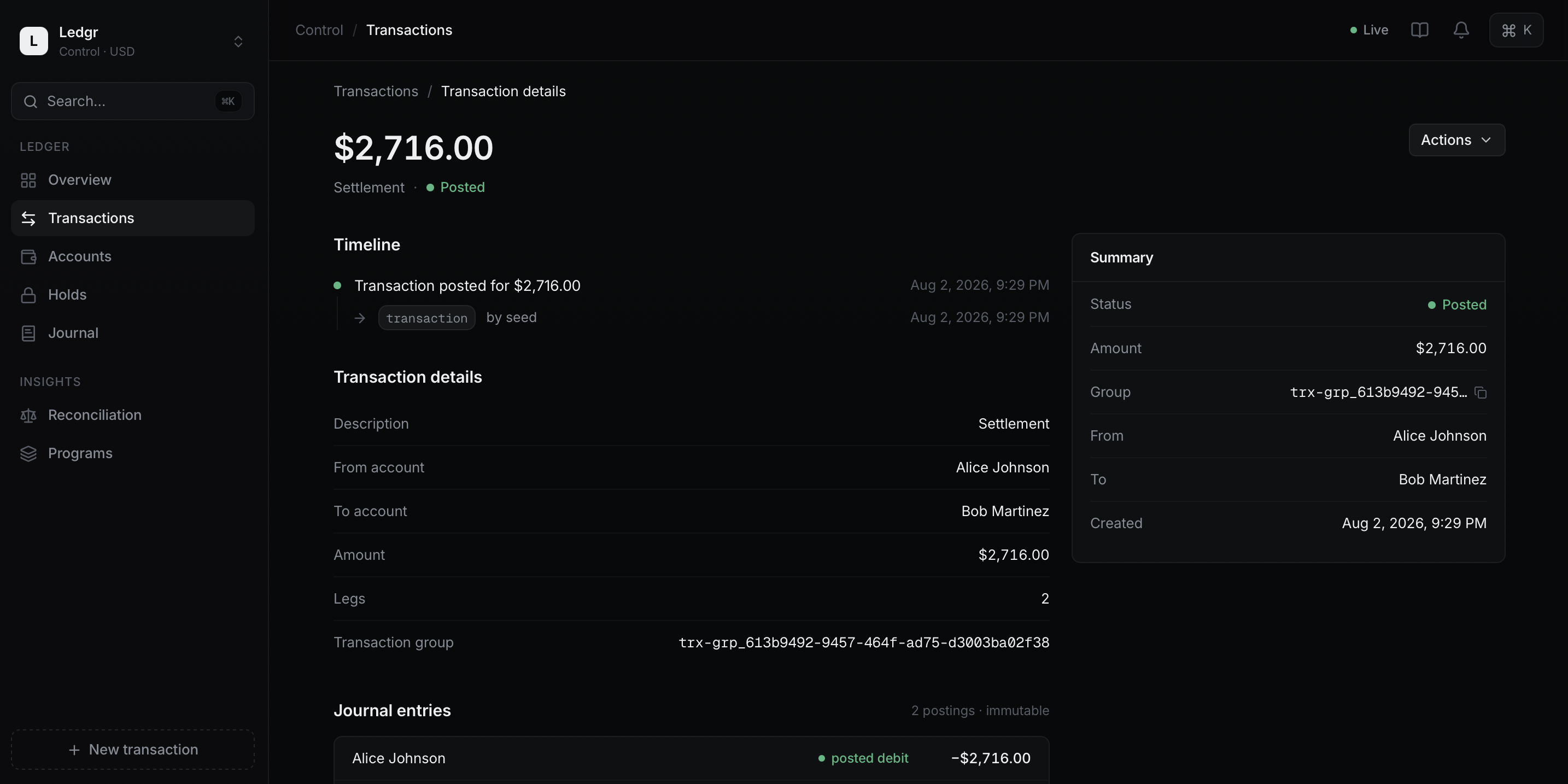
Every transaction, fully traceable.
The same entry you post through the API, with its legs, postings, and status, laid out for your team to inspect and reconcile.